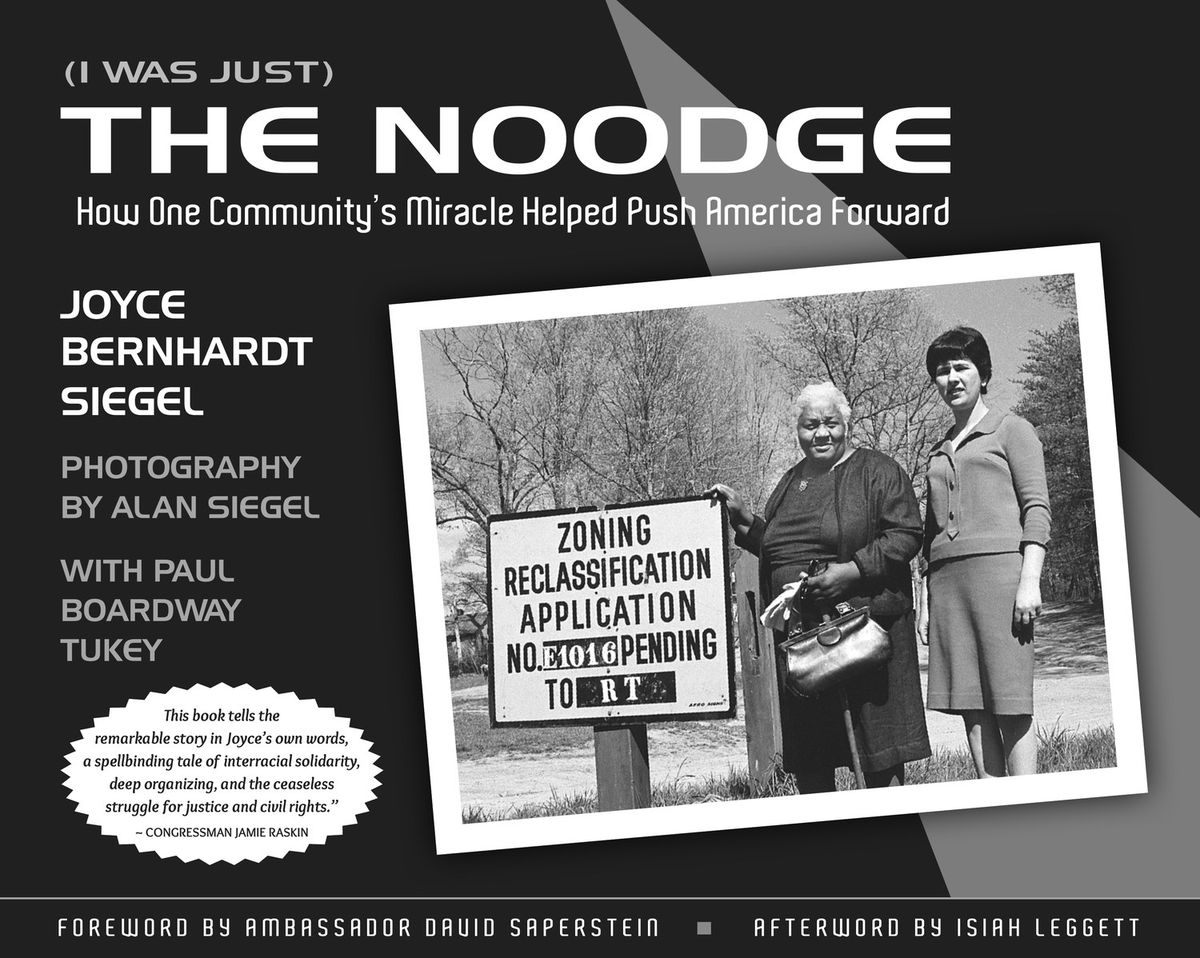
Landmark Book Recounts Civil Rights from Scotland Community Perspective
Almost immediately after learning about the plight of the historic Black community of Scotland in Potomac, Md., in the mid 1960s, Joyce Bernhardt Siegel felt an overwhelming urge to help create better living conditions.
Five years later, after she had assisted the residents of Scotland with their heroic “Save Our Scotland” effort to build the nation’s first-of-its kind housing development that still stands on Seven Locks Road, Siegel described her remarkable experiences in an early draft of her memoir.
“If nothing changed, and soon, Scotland would simply disappear,” writes Siegel, describing the post-Civil War enclave settled by formerly enslaved families in the 1800s. “I soon realized something else: charity would not be enough. Christmas parties were not enough. I didn’t know what would need to be done, but I needed to do something.”
The document, typed manually circa 1970 with copious hand-written notes in the margins, had long since yellowed and faded in her office closet by the time journalist Paul Tukey visited the Siegel home in Rockville, Md., more than a half century later.
“I’ve been hoping to find someone to help me finish this for more than 50 years,” Siegel told Tukey that day in February of 2022. “Would you be willing to take this on?”
The new book, titled The Noodge: How One Community’s Miracle Helped Push America Forward, will fulfill the dream of Joyce Siegel, now 93, who has been one of Montgomery County’s most honored private citizens since the 1960s. More than four years of research by her co-author, however, takes the book far beyond one woman’s memories and reveals a poignant untold American story from the Civil Rights era.
“When you really dive into the story of Scotland, once an impoverished Black enclave like thousands of others of that era that were literally erased from the map, you quickly find out that the little community really did help change the course of our nation’s history,” said Tukey of Potomac, an award-winning author of three prior books. “Because of the character of the people who lived there, the proximity to the White House, the mood of America related to Civil Rights and Martin Luther King Jr. — and certainly because of the self-anointed noodge, Joyce Siegel — profound changes in federal housing laws and programs occurred that impacted the entire country.”
The limited edition is elegantly designed by Thunder Mountain Publishing of Darnestown, Md., with dozens of black and white photos captured at Scotland by Joyce’s husband, Alan, from 1965-1971. The Noodge will debut during a presentation and authors’ book signing at 11 a.m. at the Montgomery History conference in Germantown on Nov. 7. A limited number of other signings will be scheduled.
The book’s 312 pages contain a Foreword by Ambassador David Saperstein, an Afterword by former County Executive Isiah “Ike” Leggett, and an Addendum by historian and author Knight Kiplinger. Stellar early reviews have already come in from a variety of local and national dignitaries including CBS sportscaster James Brown, hotelier David Marriott, and Congressman Jamie Raskin.
“This is an important and truly impressive book,” said Kiplinger, editor emeritus of The Kiplinger Letters and Kiplinger’s Personal Finance magazine. “In the turbulent 1960s, a group of caring, committed neighbors — African-American and white, Jewish and Christian, poor and well-off — bonded together to save an historic Black community from disappearing. Their remarkable story has valuable lessons for all of us today.”
By agreement with Thunder Mountain Publishing and the authors, who want to keep all proceeds in Montgomery County, The Noodge will be for sale on-line exclusively at Montgomery History (opens in a new tab). Copies will be mailed beginning Nov. 9. In addition to Montgomery History, other beneficiaries of the project will include an after-school education program for the Scotland community known as STORM (Strategies Targeting Outcomes in Reading and Math), www.scotlandstorm.org (opens in a new tab).
“My family moved to Potomac in 1964 and I remember being so shocked as a young person catching a glimpse of the terrible living conditions in Scotland that you could easily see driving by,” said Jane Perini, the co-owner of Thunder Mountain Publishing, who personally designed the pages. “I also remember being happy and relieved when the reconstruction finally took place, but I never knew how that came to be — until now. Thank you, Joyce Siegel, for all that you did then, and what you’ve done now with the creation of this landmark book.”
For more information, contact Jane Perini (Jane@ThunderMountainDesign.com).